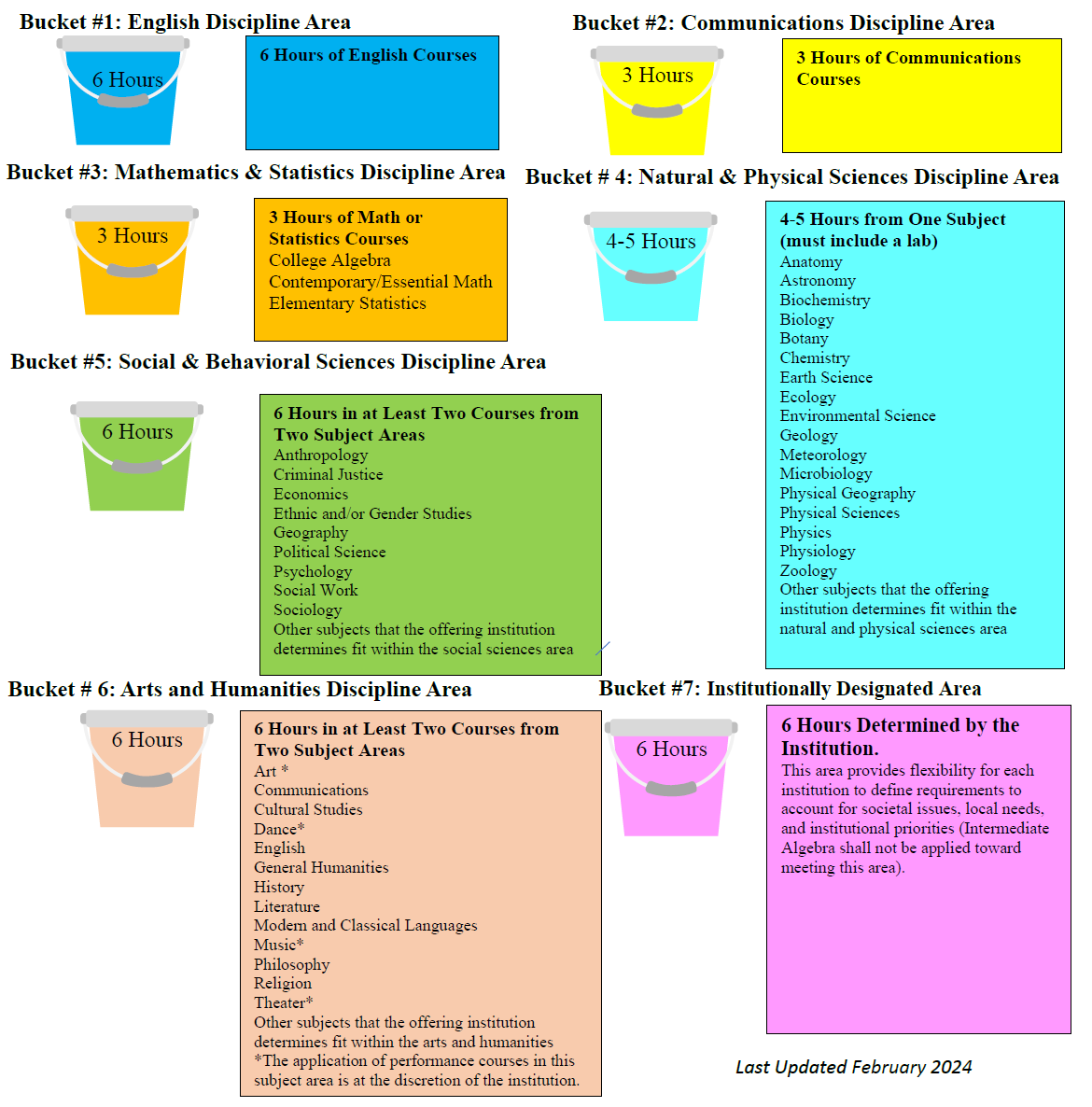
The systemwide GE program framework is below and is comprised of 34-35 credit hours organized in six discipline-based “buckets” and an institutionally designated bucket. A student who satisfies all seven buckets will complete the systemwide GE program.
Bucket 1: English Discipline Area
6 hours of English Courses
Bucket 2: Communications Discipline Area
3 hours of Communications Courses
Bucket 3: Mathematics and Statistics Discipline Area
3 hours of Math or Statistics Courses
- College Algebra
- Contemporary/Essential Math
- Elementary Statistics
Bucket 4: Natural and Physical Sciences Discipline Area
4-5 hours from one subject and must include a lab
- Anatomy
- Astronomy
- Biochemistry
- Biology
- Botany
- Chemistry
- Earth Science
- Ecology
- Environmental Science
- Geology
- Meteorology
- Microbiology
- Physical Geography
- Physical Sciences
- Physics
- Physiology
- Zoology
- Other subjects that the offering institution determines fit within the area
Bucket 5: Social and Behavioral Sciences Discipline Area
6 hours in at least two courses from two subject areas
- Anthropology
- Criminal Justice
- Economics
- Ethnic and/or Gender Studies
- Geography
- Political Science
- Psychology
- Social Work
- Sociology
- Other subjects that the offering institution determines fit within the area
Bucket 6: Arts and Humanities Discipline Area
6 hours in at least two courses from two subject areas
- Art*
- Communications
- Cultural Studies
- Dance*
- English
- General Humanities
- History
- Literature
- Modern and Classical Languages
- Music*
- Philosophy
- Religion
- Theater*
*The application of performance courses in this subject area is at the discretion of the institution.
Bucket 7: Institutionally Designated Area
6 hours determined by the institution. This area provides flexibility for each institution to define requirements to account for societal issues, local needs and institutional priorities (intermediate algebra shall not be applied toward meeting this area).
General Education Council & Operating Procedures
- Kara Wheeler - Allen Community College
- Gaile Stephens - Emporia State University
- Brad Will - Fort Hays State University
- Troy McCloughan - Fort Scott Community College
- Rachel Wannamaker - Hutchinson Community College
- Cathy Almai-Mahurin - Johnson County Community College
- Trisha Gott - Kansas State University
- Melinda Roelfs - Pittsburg State University
- Ric Steele - University of Kansas
- Beth O'Neill - Washburn University
- Gina Crabtree - Wichita State University
1. How did the Systemwide General Education start?
At the end of FY 2020, the Board expressed a strong desire to develop a more robust system-based approach to facilitate student transfer. Building on this vision, in FY 2021 and 2022, the Board established a goal to develop a systemwide general education (GE) package under a common framework. When framing this goal, the Board instructed Board staff to develop a system-based GE package that would maximize the application of credit throughout the system, simplify processes for transfer students, and remove barriers for transfer students.
At the outset of this work in September 2020, 14 out of 15 states in the central United States had some variation of a systemwide GE, with Kansas being the outlier without a systemwide GE. From September 2020 to May 2022, a GE working group consisting of 19 faculty and administrators from community colleges, universities, and one technical college, a nine-member GE implementation working group consisting of registrars and transfer academic advisors, and detailed feedback from institutions helped shape the GE framework and its related policies.
The policy revisions and additions pertaining to GE and the application of transfer GE credit were approved by the Board on June 15, 2022.
2. What policy additions and revisions were approved by the Board?
First, a new policy, the Systemwide General Education Program policy (Kansas Board of Regents Policy Manual Chapter III.A.18), creates a systemwide GE for the state universities, community colleges, and Washburn University. Most notably, this details the common system framework (disciplines, core subjects, and credit hours) that each institution will adopt, establishes institutional reporting requirements, and creates a GE Council, which will be responsible for reviewing institutional reporting, issuing recommendations regarding requests for certain majors to deviate from the GE requirements, and investigating student and institutional complaints relating to the systemwide GE program and its application to the Transfer and Articulation policy.
Second, revisions were also made to the Transfer and Articulation policy to detail how the systemwide GE program applies to transfer students. These revisions are detailed in a new section titled Transfer of Systemwide General Education Requirements (KBOR Policy Manual Chapter III. Section A.2.g.). The new language provides guidance around transfer coursework in relation to program and institution-specific GE English and communication courses. Additionally, it also outlines how GE transfer credit works for students who completed the systemwide GE and did not complete the systemwide GE.
3. Who is participating in the systemwide GE?
The six state universities and the participating coordinated institutions (for this policy, this includes the community colleges and Washburn University) will implement the systemwide GE. It should be noted that technical colleges have a statutorily defined technical function that limits their degree offerings to the Associate in Applied Science degree, which requires significantly less GE and is not primarily designed for transfer. Thus, technical colleges will not participate in the systemwide GE.
4. What degrees are included in the systemwide GE?
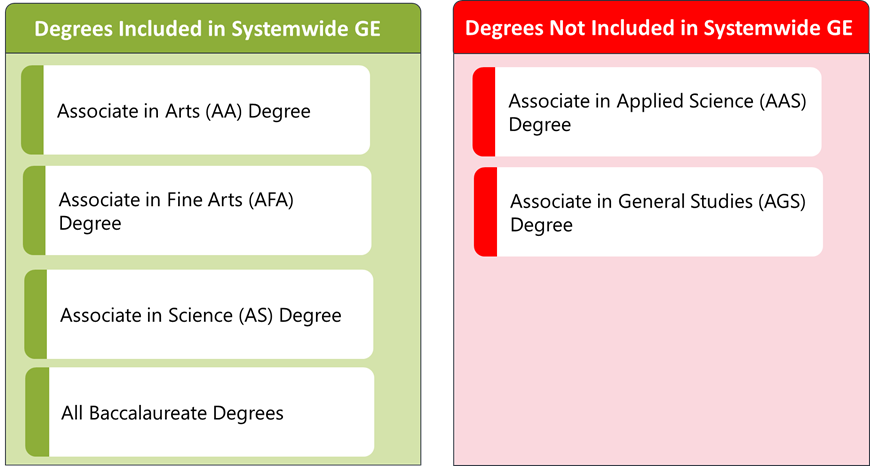
Degrees included in Systemwide General Education:
- Associate in Arts (AA) Degree
- Associate in Fine Arts (AFA) Degree
- Associate in Science (AS) Degree
- All Baccalaureate Degrees
Degrees NOT included in Systemwide General Education:
- Associate in Applied Science (AAS) Degree
- Associate in General Studies (AGS) Degree
5. Can institutions participate in certain parts of the Systemwide GE Program policy and the Transfer of Systemwide GE Requirements policy section and not participate in other parts of these policies?
No. State universities are required to comply with every aspect of both policies. Unless a coordinated institution has opted out, coordinated institutions are also required to participate in every aspect of both policies.
6. If a coordinated institution has determined that it will opt out of participating in the General Education Program policy and the Transfer of Systemwide General Education Requirements policy section, what is required and how will this information be documented?
Institution's shall follow the following process:
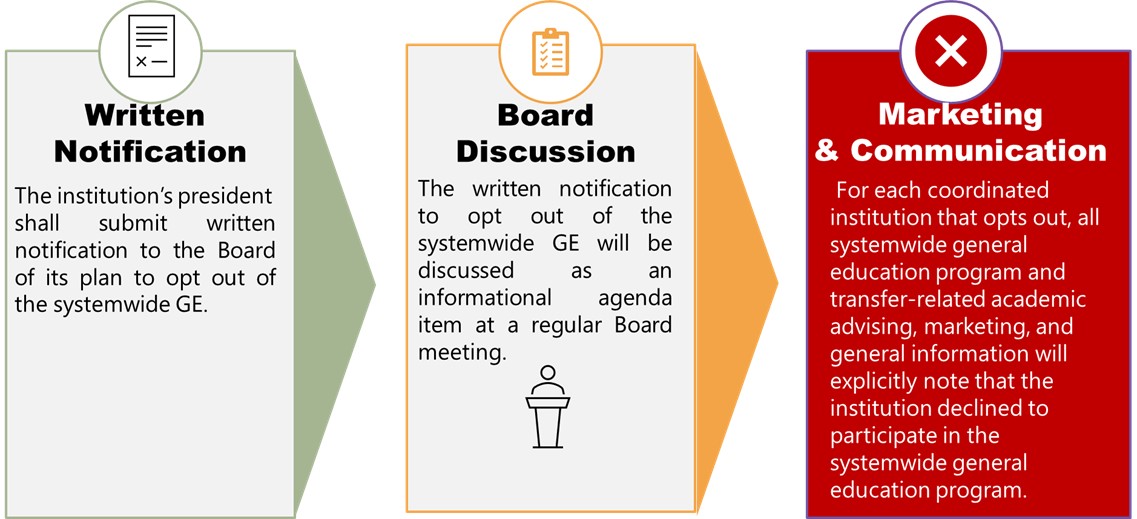
- The institution's president shall submit written notification to the Board of its plan to opt out of the systemwide General Education.
- The written notification to opt out of the systemwide General Education will be discussed as an informational agenda item at a regular Board meeting.
- For each coordinated institution that opts out, all systemwide general education program and transfer-related academic advising, marketing and general information will explicitly note that the institution declined to participate in the systemwide general education program.
The All Star High School program, launched in 2022, extends the Apply Kansas mission to enhance college access by guiding students through the application process. Students in these schools receive support in completing admissions applications, seeking financial aid, and celebrating all postsecondary paths. This ongoing series of events, sustained year after year, cultivates a college-going atmosphere throughout the entire school community.
2026 Kansas All Star High Schools
2025 All Star High school recognition

How to Become an all star high school
1. Host an Apply Kansas Event
Register as an Apply Kansas School
Host your Application Event
2. Submit your Apply Kansas Summary Data (due annually December 1st)
3. Sponsor or collaborate on a FAFSA Completion Event (typically between Oct-Feb)
Plan an event where students & parents can start on the FAFSA application together
Event should provide support to answer specific, confidential questions for families. Financial Aid officers and Admissions representatives from local institutions are often good resources and willing to come help.
FAFSA events can be held at the high school, but can also be held at higher education institutions or other community locations if you are joining together with other high schools.
Be aware of shift work, first generation, undocumented students and other underserved populations. Try to create an event at times and in locations that meets the needs of your underserved community members.
If you host a FAFSA event in the fall, consider doing something again in Jan-Feb. Many students who would benefit most from the FAFSA aren't always ready to apply in the fall. Follow up encouragement and support in the new year might be just what some students need to finalize those postsecondary plans
4. Host a Senior Signing Day Event (around May 1)
This event should celebrate the decisions and different pathways for your seniors.
It can be as big or small as you want to make it. (Some schools make it actual signing event for all seniors and invite different colleges, and some incorporate announcing the plans of all seniors into their Honors and Awards ceremony. Creating a bulletin board, banner, poster activity, t-shirt day are all some of the many great ways you can celebrate your seniors' plans) See the link in the resources below.
Whatever you plan, consider how it will look for students planning to go to work or other placements. If you are announcing college placements, how will you announce the job placements? If you do a t-shirt day, will all students be able to participate? You might have to get creative with some of the non-traditional pathways.
Consider if you can share these pathways with your underclassmen. Can you hang the banner or bulletin board for the school community to see? Are underclassmen invited to your award ceremony. By celebrating every senior, you give all of your students an opportunity to consider a post-secondary path outside of what they already know.
5. Complete the All Star High School Survey (April 1st) from Mistie Knox to describe your three events
RESOURCES
College Signing Day National Resource Website
Google Doc with College Signing Day Photos & Ideas (add your ideas to share here!)
BANNER
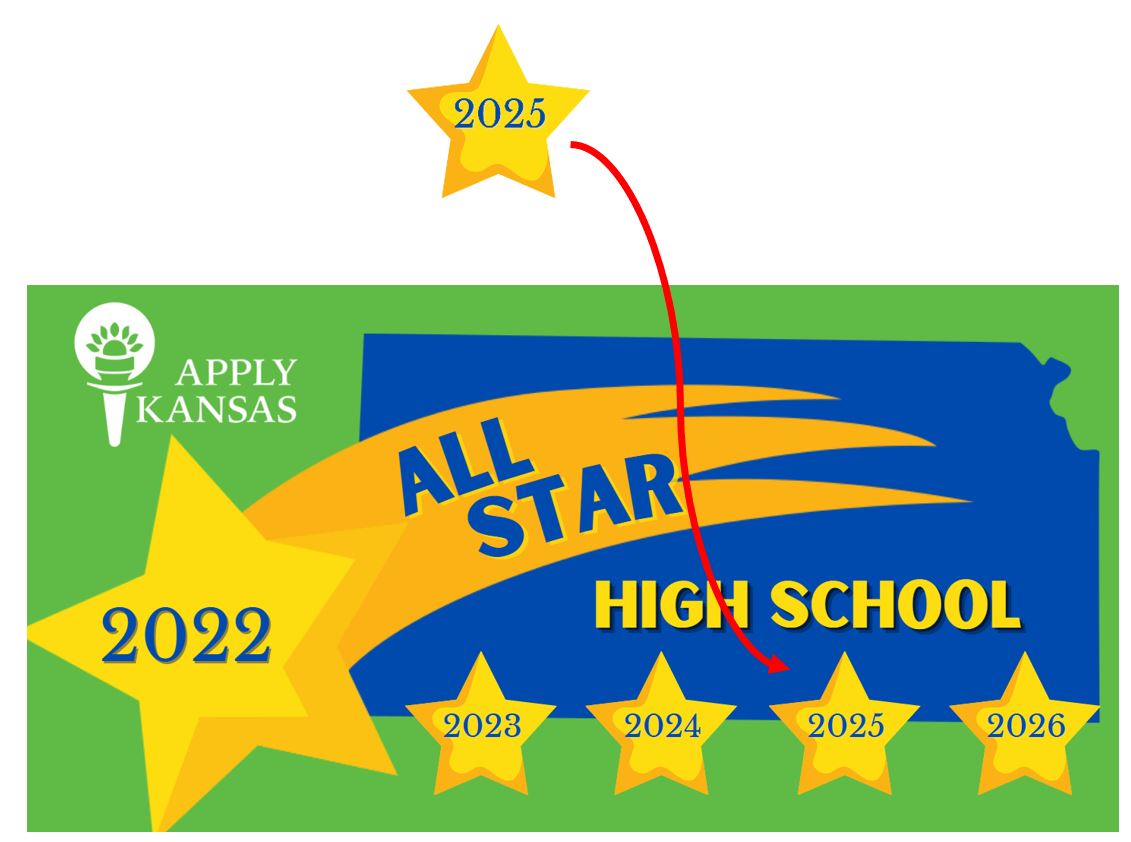
Each All Star High School will receive a certificate and vinyl banner to display at school (photo 1). Each year after that, award winning schools will receive a certificate and star sticker to add to their banner, indicating multiple award winning years (photo 2).
Year #1: Banner
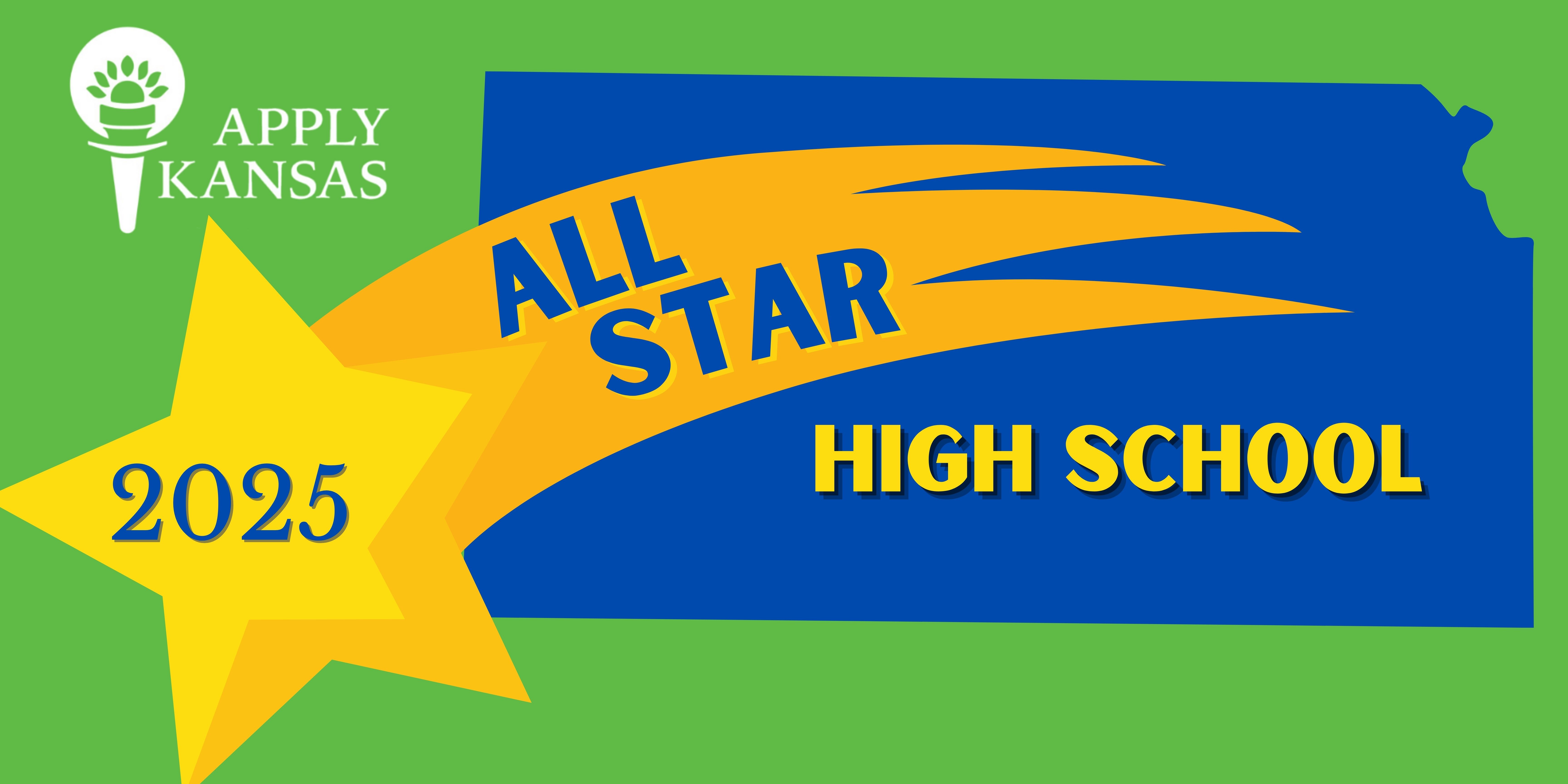
Year #2-5: Sticker
CONTACT
For more information:
Mistie Knox, Associate Director, Academic Affairs
Apply Kansas State Coordinator
2026 kansas fafsa challenge
Schools are able to track their FAFSA Completion Rate through the KBOR FAFSA Completion Project Data Access (see below).
Competition Structure
The Kansas FAFSA Challenge will be active from October 1*, or when the FAFSA opens, until June 30 each year. We use senior class size data as reported to KSDE, and the FAFSA completion numbers for this year as reported by FAFSA state-wide data. The winning schools will be announced and recognized annually.
FAFSA Challenge Leaderboard
Updated 1/28/2026
| High School | FAFSA Completion Percentage 70% or higher |
|---|---|
| Bishop Ward High School | 80% |
| Clay Center Community High | 72% |
| Greeley County Jr./Sr. High | 75% |
| Hanover High | 71% |
| Ingalls High School/Junior High | 75% |
| Macksville High | 75% |
| Plainville High | 73% |
| Quinter Jr-Sr High | 74% |
| Republic County Jr./Sr. High School | 75% |
| Solomon High | 71% |
fafsa completion project Data access
Kansas school districts are able to see your individual high school students FAFSA through the FAFSA Completion Project.
Each district submits a request for access, and the designated district contact is responsible for distributing the data to individual schools.
More information is available on the FAFSA Completion Project information website.
An application form is available on the FAFSA Completion Project application page.
FAFSA Event Resources
One of the best ways to increase FAFSA completion rates and support your students and families in navigating the FAFSA is by holding a FAFSA completion event at your school. Listed below are some lessons & resources you can share with your school community. Everything you need to plan, experts to call, and steps to follow to host a FAFSA event for your students & parents.
If you are a high school or college counselor looking to help students enter or navigate postsecondary education, many resources are available to you and your students. Explore some of the common options below.
 Explore resources to assist in applying to colleges and universities.
 Learn more about Kansas free college application days.
 Explore state student financial aid options available for your students.
 Explore a wide array of resources available to help students and families complete the FAFSA.
 DegreeStats provides cost information for every degree at a Kansas public university or college.
 Learn about the requirements for admission to state universities in Kansas
 More than 100 courses transfer seamlessly across the 32 public colleges and universities in Kansas.
 KBOR recognizes high schools with the highest percentage of students completing the FAFSA.
 Concurrent enrollment partnerships facilitate the teaching of college-level learning at high schools.
 Find tools, strategies, and insights to enhance your support as students navigate their path to success.
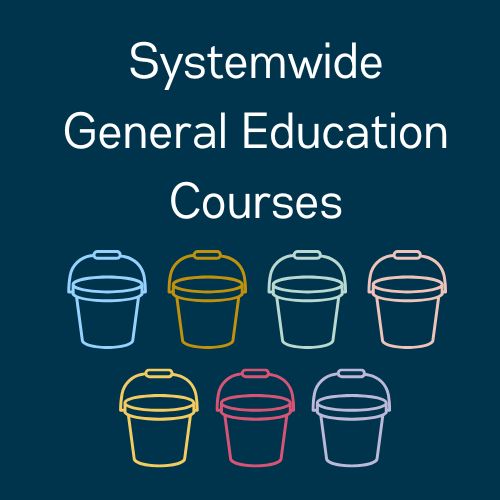 Review Institutional list of courses aligned with the Systemwide General Education Framework.
POSTSECONDARY PLANNING RESOURCES
Any resources are meant to be used in your program or shared with your students. If you have something that you think would be helpful to share with other counselors in Kansas, please email Mistie Knox,
Kansas Qualified Admission Requirements: This link will take you to the Kansas QA webpage, where you can learn more and download a flyer to share with your students
Kansas Admission Guide: This document lists every higher education institution in Kansas, provides links to admission and financial aid, and shows priority scholarship deadlines when appropriate.
Kansas Postsecondary Exploration Guide: This document lists higher education institutions in Kansas, provides links to admission and financial aid, and provides additional exploration resources.
Conference Presentation Materials
Kansas School Counseling Association Conference - May 27, 2025
Topics covered: Apply Kansas, All Star High School, Apply Free Days, Systemwide General Education Framework, and Systemwide Transfer.
Slides from May 27, 2025 presentation
Kansas State College Advising Corps Pre-Service Training - August 7, 2024
Topics covered: Apply Kansas, Apply Free Days, All Star High School, Transfer Portal, Math Pathways, Systemwide Transfer, Systemwide General Education, Academic Degree Maps, Scholarship, CTE resources, and other helpful resources available through KBOR.
Slides from August 7, 2024 Presentation
August 7, 2024 Recording (25 min)
Kansas Association for Career and Technical Education Conference - July 30, 2024
Topics covered: Students Right to Know Act, KS Degree Stats, Systemwide Transfer, Transfer KS portal, Math Pathways, Kansas Apply Free Days, Statewide Articulation Agreements, Excel in CTE, CTE Credential and Transition Incentive, Scholarships, Kansas Promise Act, and Comprehensive Local Needs Assessment.
Slides from July 30, 2024 presentation
Kansas School Counseling Association Conference - May 28, 2024
Topics covered: Apply Kansas, All Star High School, Apply Free Days, Systemwide General Education Framework, and Systemwide Transfer.
Slides from May 28, 2024 presentation
previous KBOR WEBINARs
Kansas State College Advising Corps PD series
Creating a College and Career Going Culture in your School
Date: January 21, 2026
Advising College Going Seniors
Date: February 18, 2026
Exploration for the Teenage Soul
Date: March 11, 2026
Helping your Seniors Become Career Ready
Date: April 15, 2026
For more information visit the Kansas State College Advising Corps website.
2024 High School Heroes webinar series
September: Essential KBOR Resources for You and Your Students
Featuring: Important Websites and Resources for Year-Round Student Support
Slides from September 2024 presentation
September 2024 Recording (30 min)
October: Unlocking Student Success: Expert Advising Tips and Tricks
Featuring: Best Practices in Advising to Leverage Dual Credit Options
Panelists:
- Kris Farmer, Director of Advisement and Retention at Cloud County Community College
- Loni Jensen, Director of High School Partnerships at Butler Community College
- Luke Dowell, Vice President of Academic Affairs at Seward County Community College
- Nikki Brown, Assistant Director of the Academic Advising and Career Exploration Center at Fort Hays State University.
- Sara M. Smith, Assistant Dean of Instruction at Highland Community College
-
Jake Brillhart, Academic Advisor at the University of Kansas Jayhawk Pre-Law Advising
October 2024 Recording (60 min)
November: FAFSA: Essential Updates and Insights
Featuring: Important updates, resources, impact of the FAFSA, and the FAFSA Completion Challenge
November 2024 Slides
November 2024 Recording (20 min)
December: Fast Track to Degree: Accelerating Success During High School
Featuring: AP and Cambridge International
Presenters:
Andy Houpt, Kansas School Development Manager at Cambridge International
Pam Kerouac, Higher Education State Policy Consultant at Cambridge International
Mike Nick, Senior Director of K12 State Partnerships at College Board
December 2024 Cambridge International Slides
December 2024 AP College Board Slides
December 2024 Recording (45 min)
CLEP for high schools
Tuesday, September 10th, 9-10am
The College-Level Examination Program (CLEP) has been assisting students in earning college credit since 1967. With 34 exams in 5 broad categories, CLEP is used by students of all educational levels, military-affiliated students, and varying educational backgrounds to show mastery of college-level material. Discover the latest research that supports CLEP for students and institutions, data and trends of CLEP participation, best practices of how to utilize CLEP as well as resources for both students and educators.
Presenter: Gini Beran, Director of CLEP Outreach
September 10 CLEP for High Schools Recording (30 min)
Slides from September 10 CLEP for High Schools Presentation
2024 july - College trends and students right to know act
The presentation explored key trends in higher education, including data on high school graduation rates, college enrollment patterns, and the college going rates based on student demographics. We also covered statistics on Pell Grant eligibility, ACT college readiness benchmarks, and disparities in readiness across race, ethnicity, and family income. Additionally, we highlighted resources from the Kansas Board of Regents (KBOR) designed to support students in their postsecondary planning.
July 2024 Recording (16 min)
2024 April - FAFSA for Educators
Educators working with high school students are invited to join KBOR and Kansas Association of Student Financial Aid Administrators to learn more about financial aid and ensure students receive the most accurate and up-to-date information. Whether you are seasoned at assisting students with financial aid or new, don’t miss this valuable opportunity to better support your students on their path to higher education.
Topics include: Types of Aid Available, Overview of Eligibility, Typical Timeline, Importance of filling out the FAFSA for all students, and some time for Q&A. The same topics will be covered on each date.
Presenters: Mistie Knox, KBOR Associate Director, Academic Affairs & Leah Nicholson, KASFAA Chair of the Outreach Training Committee
April 2024 FAFSA for Educators Recording (46 min)
April 2024 FAFSA for Educators Presentation Slides
2023 NOVEMBER- 2024 FAFSA CHANGES & UPDATES
Wed. Nov. 8 12:30pm- FAFSA Changes & Updates
The Department of Federal Student Aid is changing the Free Application for Federal Student Aid. Scheduled to open for students in December 2023, this "Better FAFSA" will expand eligibility for Federal Financial Aid, Reduce Barriers for certain students populations & offer a better user experience for those completing the FAFSA. This webinar will share the changes in the new form that we know now, show counselors how to help their students and families create an FSA ID now, review expectations and likely deadline changes for the delayed FAFSA opening and share more information about our Kansas State Scholarships.
Presenters: Michele Arellano, KBOR Director for Student Financial Assistance & Tara Lebar, KBOR Associate Director, Academic Affairs
November 2023 FAFSA Changes & Updates Webinar Recording (Click the link for YouTube Webinar Recording)
November 2024 FAFSA Updates Presentation Slides & November 2024 FAFSA Updates Presentation Resources
2023 APRIL- SYSTEMWIDE GENERAL EDUCATION PACKAGE
Tues. April 11 10:00am- Systemwide General Education for KS High School Professionals
The Kansas Board of Regents recently approved a new Systemwide General Education Package for all public higher education institutions beginning in the fall of 2024. This 34-35 credit hour general education package should transfer as a complete set to any other Kansas public institution, which will undoubtedly change how we advise our transfer students and high school students taking concurrent & dual credit courses. Come and learn about the basics of the new policy, the seven-course categories, how our systemwide transfer courses fit into the plan, and any potential exceptions. Get ready to start thinking about how your advising might look different for the class of 2024!
Presenter: Tara Lebar, KBOR Associate Director, Academic Affairs
Systemwide Gen Ed Overview for KS HS Professionals April 2023 Webinar Recording
April 2023 Presentation Slides & April 2023 Systemwide Transfer Courses for Gen Ed Resource
KBOR Systemwide General Education Website
2022 SEPTEMBER- KBOR COUNSELOR RESOURCES & STUDENT SCHOLARSHIPS
Wed. Sept 28 10:00am- KBOR Counselor Resources & Student Scholarships
The Kansas Board of Regents (KBOR) has several tools to help high school professionals assist their students with post-secondary planning. Come learn about the programs, resources and scholarships available for you and your students!
Presenters: Tara Lebar, KBOR Associate Director, Academic Affairs & Michele Arellano, KBOR Director of Student Financial Assistance
KBOR Counselor Resources & Student Scholarships September 2022 Webinar Recording
September 2022 Presentation slides with live links to resources