
- At www.ged.com, select “Grads and Transcripts” from the menu at the top of the screen.
- Under the "Requests Transcripts" section, select either "GED Grads" or "Third Parties."
- Under the drop-down menu labeled "Where did you earn your GED?" select Kansas.
- Under the "When did you earn your GED?" section, select either “2014 and Later” or “Before 2014,” depending on the date of completion. The system will then prompt users to create or access the GED account. Follow the prompts to order official records.
- For additional assistance, contact Parchment using the Chat feature at www.parchment.com
or call the Parchment Help Line at 847-716-3005.
Systemwide Transfer Associate Degrees
Elementary Ed (PK-6) Transfer Associate (pdf)
Business Administration, Management, & Operations Transfer Associate (Check Sheet - Institution Form for AY 2027)
Computer Science Transfer Associate (pdf)
- Example Check Sheet (pdf)
Pre-Bachelor of Science in Nursing Transfer Associate (Check Sheet - Institution Form for AY 2027)
Pre-Social Work Transfer Associate (Check Sheet - Institution Form for AY 2027)
Systemwide Associate-to-Baccalaureate Programs
The Kansas Board of Regents adopts this Statement on Free Expression to reaffirm the System's long-held commitment to full and open inquiry and discourse, and the robust exchange of ideas and perspectives by students enrolled in our State Universities and present on our State University campuses. The principles of freedom of speech and freedom of expression in the United States and Kansas Constitutions, in addition to being legal rights, are essential to achieving the three-part university mission to deliver a high-quality academic experience for our students, engage in meaningful and productive research, and provide other valuable public services for the benefit of our local communities, the State of Kansas, the nation, and the world. The purpose of this Statement is to express our continuing dedication to these principles and to maintaining our campuses as environments where the open exchange of knowledge and expression of ideas furthers our mission. This Statement generally concerns student expression in non-academic situations; it does not attempt to address the rights of non-students or students' academic work within the classroom setting.
A fundamental purpose of an institution of higher education is to provide an environment where divergent ideas, opinions, and philosophies can be rigorously debated and critically evaluated. Through this process, often referred to as the marketplace of ideas, students are generally free to express their ideas and opinions, even if others may disagree with them or find those ideas and opinions to be disagreeable or even offensive. The very process of debating divergent ideas and challenging others' opinions develops the intellectual skills necessary to think critically and respectfully argue through civil discourse. The development of these important skills leads to personal and scholarly growth and is an essential component of the academic and research missions of each of our institutions.
It is equally important that we, as governmental entities, not stifle the lawful dissemination of students' ideas, even if we or members of our communities find those ideas abhorrent. Students wishing to express ideas with which others may disagree must generally be free to do so without fear of being disciplined by the University. This does not mean that such ideas are necessarily endorsed or tolerated, nor should they go unchallenged by members of the University community openly and vigorously contesting their merit, but the Board and the Universities are prohibited from pursuing disciplinary or punitive actions that unlawfully inhibit or penalize protected expression. And though we value civil behavior and believe all members of our campus communities have a responsibility to promote and maintain a climate of civility and mutual respect, the Board, and by extension the Universities they govern, cannot use a desire for civility and respect as the basis to silence expression. The Board and the Universities should empower, enable and encourage students to speak and listen and to do so respectfully, rather than interfere with or silence their protected expression of ideas.
We also recognize, however, that some speech is not protected, such as true threats,1 incitement to imminent violence,2 "fighting words,"3 and unlawful, targeted harassment.4 The Board and its Universities can restrict speech that is not protected by the First Amendment, though it is important to note that these exceptions are narrowly interpreted. Additionally, reasonable restrictions on when, where, and how expression is disseminated are allowable and appropriate. Because universities and colleges are first and foremost places where people go to engage in scholarly endeavors, it is necessary to the efficient and effective operations of each University for there to be reasonable limitations on the time, place, and manner in which First Amendment rights are exercised. By law, these time, place, and manner limitations must be narrowly drawn and content-neutral and must serve to ensure that our students have the opportunity to express their ideas and opinions.
The Kansas Board of Regents is committed to protecting and encouraging students' exercise of their First Amendment free speech rights in accordance with this Statement.
A copy of the signed March 17, 2021 statement adopted by the Board.
Credits
Concepts and language for this Statement were gleaned from the following sources: State University System of Florida Statement on Free Expression, the Chicago Principles Report of the Committee on Freedom of Expression, Kansas State University' s Statement on Free Speech and Expression, the Arizona Board of Regents Policy on Free Expression, and the Iowa Board of Regents Policy on Free Expression. We are grateful for the work of these organizations.
References
1 Criminal threats directed at a specific individual or group with the intent of placing the individual or group in fear of bodily harm or death. Watts v. United States, 394 U.S. 705, 708 (1969). Back to reference 1.
2 The government may prohibit speech advocating the use of force or crime if the speech "is directed to inciting or producing imminent lawless action," and is "likely to incite or produce such action." Brandenburg v. Ohio, 395 U.S. 444 (1969). Back to reference 2.
3 Personally abusive epithets in one' s face, tending to cause an immediate violent reaction. Chaplinsky v. State of New Hampshire, 315 U.S.568 (1942), citing Cantwell v. Connecticut, 310 U.S. 296, 309, 310 (1940). Back to reference 3.
4 Conduct sufficiently severe or pervasive "to alter the conditions of [employment] and create an abusive working environment." Meritor Savings Bank v. Vinson, 477 U.S. 57 (1986). Davis v. Monroe County Board of Education, 526 U.S. 629 (1999) ("whether an environment is 'hostile' or ' abusive' can be determined only by looking at ... the frequency of the discriminatory conduct; its severity; whether it is physically threatening or humiliating, or a mere offensive utterance; and whether it unreasonably interferes with an employee' s work performance"). Back to reference 4.
Kansas Board of Regents Student Financial Aid Text Messaging Service Privacy Policy
Last update: February 2026
Overview
Kansas Board of Regents (KBOR) Student Financial Aid (SFA) respects the privacy of our scholarship applicants. This Privacy Policy explains how KBOR SFA collects, uses, and protects personal information in connection with our text messaging services.
This privacy notice provides more specific information on how the Kansas Board of Regents text messaging service collects and processes scholarship applicant personal information.
Scope
This notice applies to the collection and processing of personal information through the KBOR SFA text messaging service (“we,” “us,” or “our”). It provides an overview of our practices regarding the information we collect, how we use it, and the measures we take to safeguard it.
How We Collect Information
We collect personal information in the following circumstances:
- We may collect personal information in the following ways:
- Direct Collection: When you voluntarily provide information by responding to KBOR SFA text messages.
- From KBOR Sources: When your contact information is imported from other authorized KBOR systems or sources, such as scholarship or financial aid applications.
- Automated Processes: When the text messaging platform automatically collects limited technical or interaction data as you engage with our messages.
What Type of Information We Collect
Direct Collection
We directly collect the following personal information:
- Mobile phone numbers
- Opt-out preferences
- Content of your text message responses to us.
Collection from KBOR Sources
We import personal information from KBOR Student Financial Aid scholarship application systems and sources, including:
- First and last name
- Mobile phone number
Automated Collection
The text messaging platform automatically collects certain technical details, including:
- Device status (e.g., whether the device is available for messaging)
- Carrier (e.g., Verizon, AT&T, etc.)
- Country associated with the phone (note: KBOR does not send international text messages)
- Message delivery status
- Error codes indicating message delivery issues (e.g., number associated with a landline, unreachable device, etc.)
How This Information Is Used
We use the personal information we collect to communicate with you regarding the status of Kansas Board of Regents Student Financial Aid Scholarship applications, such as:
- Updates, to keep you informed of important dates or requirements specific to your KBOR SFA Scholarship application.
With Whom This Information Is Shared
KBOR does not sell or rent your personal information. We may, however, share your information in limited circumstances, such as:
- With Service Providers: We share information with our text messaging services.
- With Partners: When necessary, we may share information with university partners or other entities that support KBOR SFA scholarship administration.
All service providers are required to maintain appropriate safeguards, keep your personal information secure, and use it only to provide necessary services on our behalf.
We may also share personal information when required by law or when we believe such disclosure is necessary to protect the safety, property, or rights of KBOR, its employees, students, or scholarship recipients.
What Choices You Can Make About Your Information
You may choose to unsubscribe from text messages at any time. To stop receiving messages, reply with one of the following keywords:
“Cancel,” “End,” “Quit,” “Unsubscribe,” “Stop,” or “Stop All.”
To resume receiving messages, reply with:
“Start,” “Yes,” or “Unstop.”
Text "HELP" for help.
Please note:
- Unsubscribing from one campaign does not automatically unsubscribe you from others.
- Unsubscribing does not remove your information from KBOR source systems (e.g., scholarship applications).
To ensure you continue receiving important updates, please verify that your contact information in the KBOR Scholarship Portal is accurate and up to date.
If you would like to opt-in to receiving text messaging, please complete the Kansas Board of Regents Student Financial Assistance Text Messaging Consent Form
How Information Is Secured
Kansas Board of Regents Student Financial Aid recognizes the importance of protecting the information it collects and maintains. KBOR SFA employs reasonable physical, administrative, and technical safeguards designed to prevent unauthorized access, maintain data accuracy, and ensure the proper use of information.
Mobile phone numbers and SMS opt-in consent are collected solely for the purpose of delivering the text messages described at the time of opt-in. SMS opt-in data and consent will not be sold, rented, shared, transferred, or disclosed to any third parties or affiliates for marketing or promotional purposes.
We do not share text messaging originator opt-in data or consent with any third parties, except with trusted service providers that assist us in delivering SMS communications (such as messaging platform providers), and only for the purpose of facilitating message delivery and related support services.
Privacy Notice Changes
This privacy notice may be updated periodically to reflect changes in practices or applicable laws. The effective date of the most recent update will always appear at the top of this notice.
SMS Terms and Conditions (PDF)
Who to Contact with Questions or Concerns
If you have questions or concerns about this Privacy Policy or how your personal information is used, please contact:
Kansas Board of Regents – Student Financial Aid
Email:
Join us as we bring together educators, families, and literacy advocates from across Kansas to champion strong reading instruction for every child. Together, we’re supporting the Blueprint for Literacy—a statewide effort focused on equipping teachers with evidence-based tools and improving reading outcomes for all students. Your voice matters—help us make literacy a priority at the Capitol!
Event: Literacy Day at the Capitol
Time: 9:30 a.m. -1 p.m.
Location: Kansas Statehouse
Registration Information
Registration Link: https://www.zeffy.com/en-US/ticketing/2026-literacy-day-at-the-capitol
Agenda
9:30 – 9:45 AM — Welcome & Opening Remarks, 2nd Floor Rotunda
- Chair Cathy Hopkins, State Boad of Education Chair, KSDE
9:45 – 10:00 AM — Literacy as a Social, Economic, and Health Imperative, 2nd Floor Rotunda
- Speaker: Regent Kathy Wolfe Moore, Kansas Board of Regents
10:00 – 10:15AM – Importance of Literacy to Families and Communities
- Speaker: Representative Troy Waymaster
10:15 – 10:35 AM — State of Literacy Briefing, 2nd Floor Rotunda
- Speakers: Dr. Randy Watson, KS Commissioner KSDE, and Dr. Cynthia Lane, Director for Literacy, KBOR
10:35 – 11:05 AM — Break (visit with community tables), 2nd Floor Rotunda
11:05 – 11:40 AM — Parent/Educator Testimonials, 2nd Floor Rotunda
11:40 PM – 12:00 PM — Closing & Call to Action, 2nd Floor Rotunda
- Brief remarks from speaker (TBD)
Lunch 4th Floor South Hall
1:30-2:30 PM – House & Senate Education Committee Session
Infographics
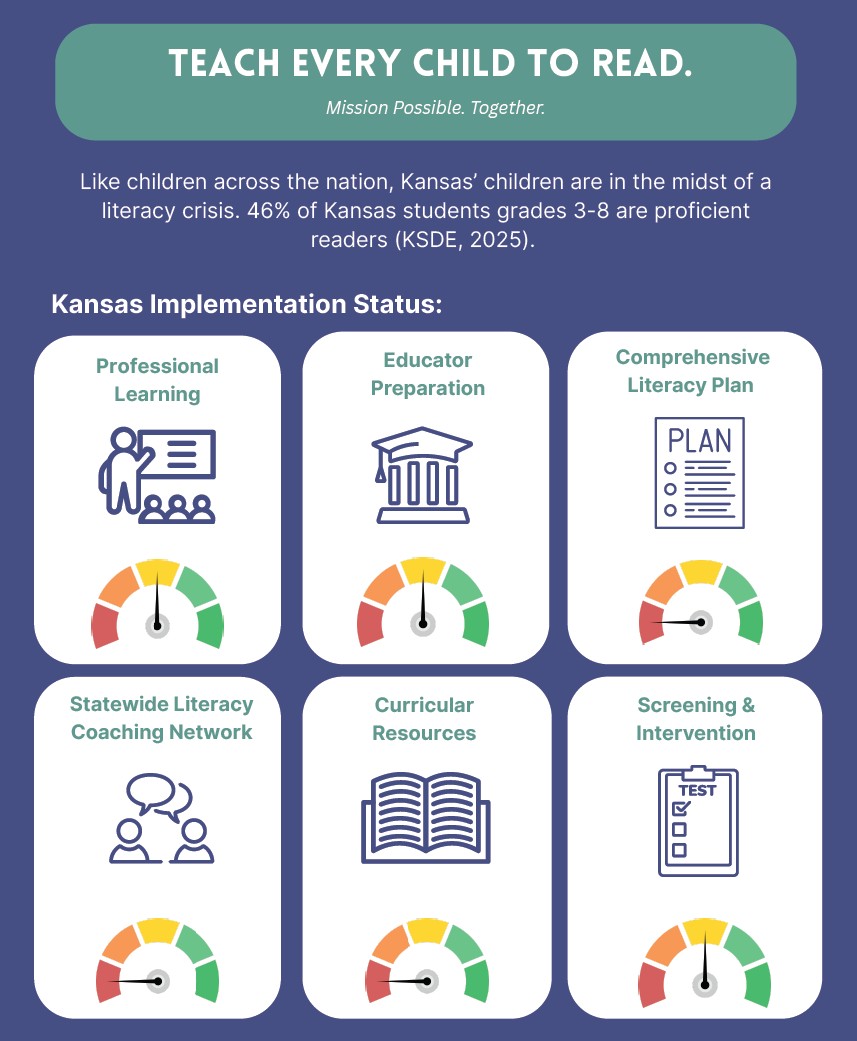
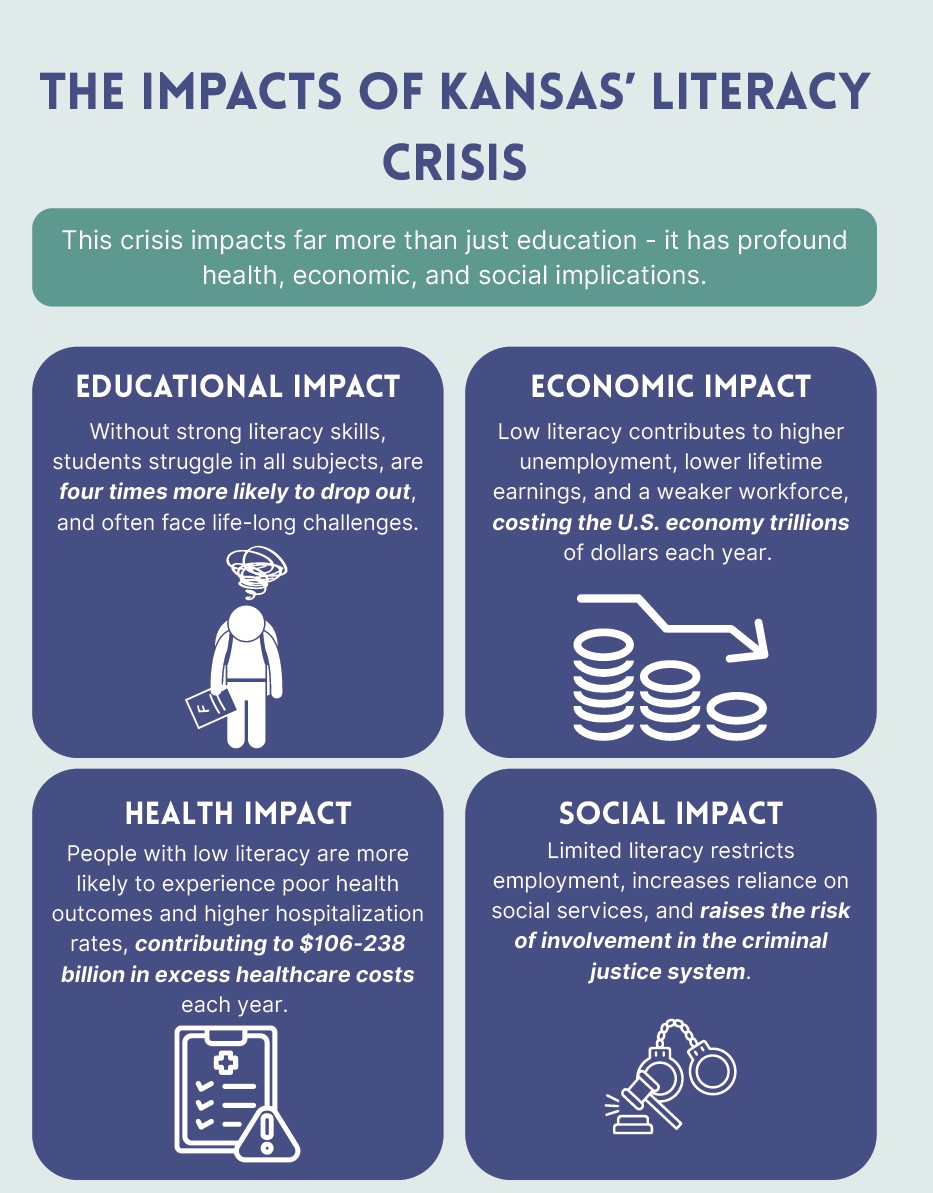
Learn more about the literacy challenges facing Kansas and the Blueprint's work by clicking on the infographics below.
|
|
|