The Workforce Development unit focuses efforts and resources to prepare workers for careers in Kansas’ highest-priority fields, such as health care, advanced manufacturing/aviation, energy, and health sciences. Education and training in these critical industries will help ensure a strong Kansas economy long into the future. Successful workforce development programs improve our learners’ employability and earnings potential and continued profitability for employers. The Workforce Development unit:
- serves as the link between higher education and the workforce and economic needs vital to local communities and the state;
- fosters economic development in the state by providing leadership in defining and advocating statewide economic development initiatives;
- partners with the Kansas Department of Commerce and Kansas Department of Labor to develop an integrated education and workforce training system that unifies efforts, produces highly skilled workers, and leverages resources to aligned priority needs and maximize benefits;
- supports college partners as they provide high-quality, cost effective, short-term, career-relevant training solutions, as well as academic programs and certifications aligned with the needs of today's employers.
KANSAS DEPARTMENT OF COMMERCE PARTNERSHIP
Agency leadership at the Kansas Department of Commerce (Commerce) and the Kansas Board of Regents (the Board) recognize the link between economic development and workforce development. Both the Kansas Framework for Growth and Building a Future documents describe the critical importance of this relationship.
Commerce holds a seat on the Technical Education Authority and the Board holds a seat on the state Workforce Board. The two agencies work on various initiatives together such as:
Workforce Innovation and Opportunity Act
Workforce Innovation and Opportunity Act (WIOA) is administered by the Kansas Department of Commerce and provides funding for four separate programs: Adult Programs, Dislocated Worker Program, Youth Program, and Wagner-Peyser Labor Exchange. WIOA requires State Workforce Agencies to partner with other State Agencies (which administer Vocational Rehabilitation and Adult Education) in the collaborative strategic four-year plan, approved by the state Workforce Board, describing how WIOA will be implemented in the state. WIOA State Plans are available at https://wioaplans.dol.gov/.
Kansas Micro-Internships
Kansas Micro-Internships are short-term, paid, professional assignments in sales, marketing, finance, human resources, technology, and many other areas. These projects can be completed remotely year-round and typically range from 5 to 40 hours of work. The projects are usually due within a month after kick-off and are preceded by the intern completing the Agile Work Profiler developed by the DeBruce Foundation. Through this program, Kansas-based companies and nonprofit organizations that select a student who is currently enrolled in a Kansas public two-year college or four-year university is eligible to receive a 50% matching micro-grant up to $250 per project (for a maximum of two projects).
These Micro-Internship projects serve as a bridge to future employment opportunities and help organizations find their next great hire. For more information or to register for the program, visit https://info.parkerdewey.com/kansasemployers.
The Kansas Postsecondary Technical Education Authority (TEA) was established by the Kansas Legislature in 2007. As delineated through legislation, the TEA functions under the auspices of the Kansas Board of Regents and makes recommendations to the Regents regarding the coordination, statewide planning and improvements/enhancements to the postsecondary technical education system. The TEA is comprised of 12 appointed members.
The TEA has set a rapid pace on the road toward improvement of the postsecondary technical education system in the state. The Vision, Mission, and Strategic Priorities of the TEA respond directly to legislative direction focusing technical program offerings, including the review and recommended approval of new and existing technical programs; development of new approaches to funding postsecondary technical education; development of accountability indicators; and coordinating the development of a seamless system between secondary and postsecondary technical education levels.
Vision: To be a national leader of premier technical education by developing a highly prepared Kansas workforce.
Mission: Drive the advancement of a robust technical education system to meet the needs of Kansas business and industry.
DOWNLOAD: TEA Goals 2024-2025 (pdf)
RESOURCES
The policies contained in the Kansas Board of Regents Policy Manual are subject to change by formal action of the Board. If ever there is a conflict between the provisions of the manual and the official minutes of the Kansas Board of Regents, the official minutes will control. The complete manual can be viewed by downloading the PDF below.
The Kansas Board of Regents is comprised of nine members, each of whom is appointed by the Governor of Kansas. Current Board members are listed below. Each Board Member also serves on various committees that address higher education issues. Their terms of office are indicated in parenthesis following their names.
|
Pamela Clancy Ammar |
Blake Benson |
Matt Crocker |
|
John B. Dicus |
Alysia Johnston |
Diana Mendoza |
|
Neelima Parasker |
|
Kathy Wolfe Moore |
|
Blake Flanders |
The nine-member Kansas Board of Regents is the governing board of the state’s six universities and the statewide coordinating board for the state’s 32 public higher education institutions (six state universities, one municipal university, nineteen community colleges, and six technical colleges).
In addition, the Board administers the state’s student financial aid, adult education, high school equivalency, and career and technical education programs. Private proprietary schools and out-of-state institutions are authorized by the Kansas Board of Regents to operate in Kansas.
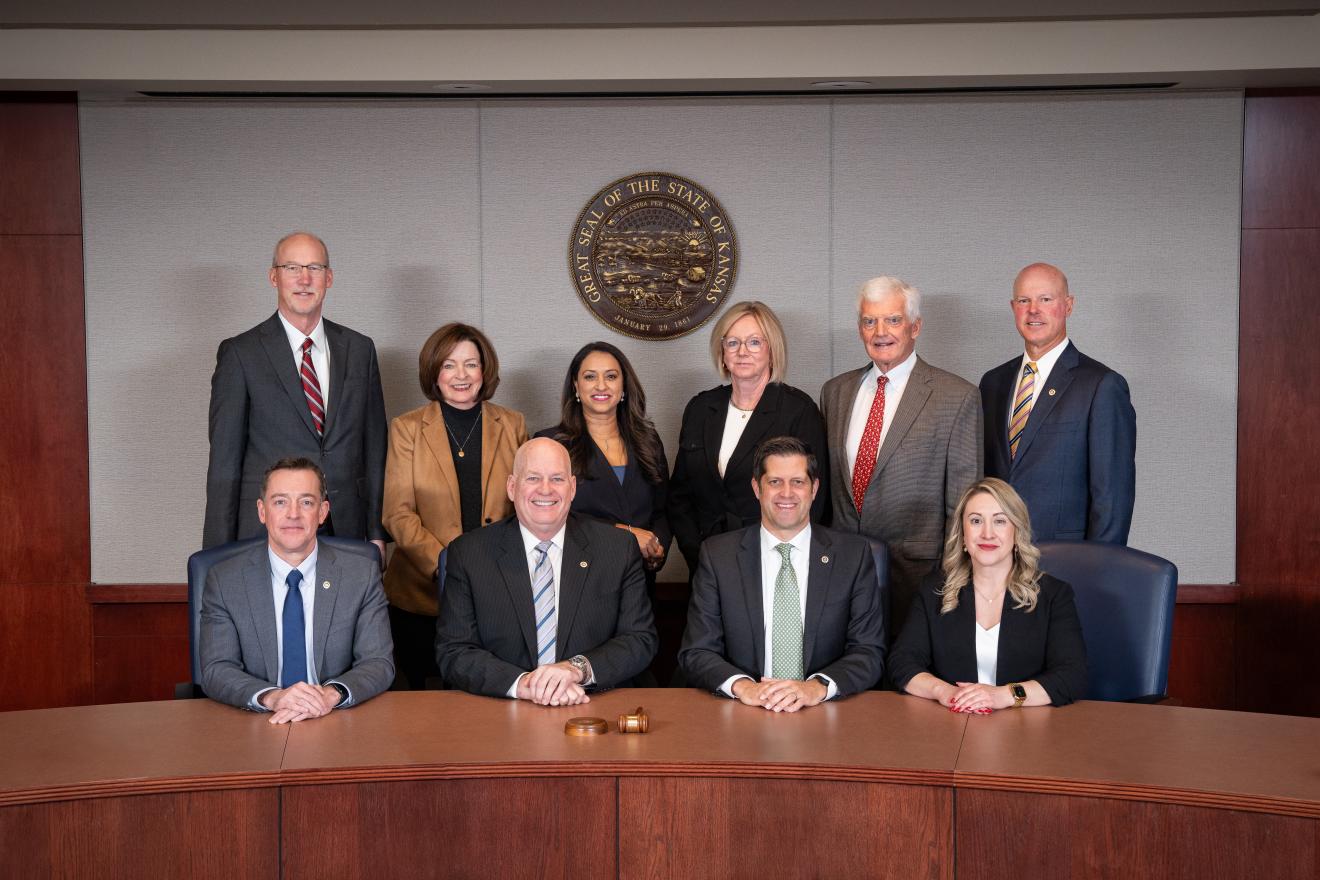
Kansas Board of Regents - March 2025